
Why Nepal’s International Airports Still Face an Air Route Problem
Gautam Buddha and Pokhara international airports struggle with commercial viability as incoming flights face costly hundreds-of-kilometer detours without direct western entry corridors from India.

 Facebook
 WhatsApp
 X (Twitter)
 LinkedIn
 Telegram
 Reddit
 Threads
 Bluesky
 LINE
 Viber
 Pinterest
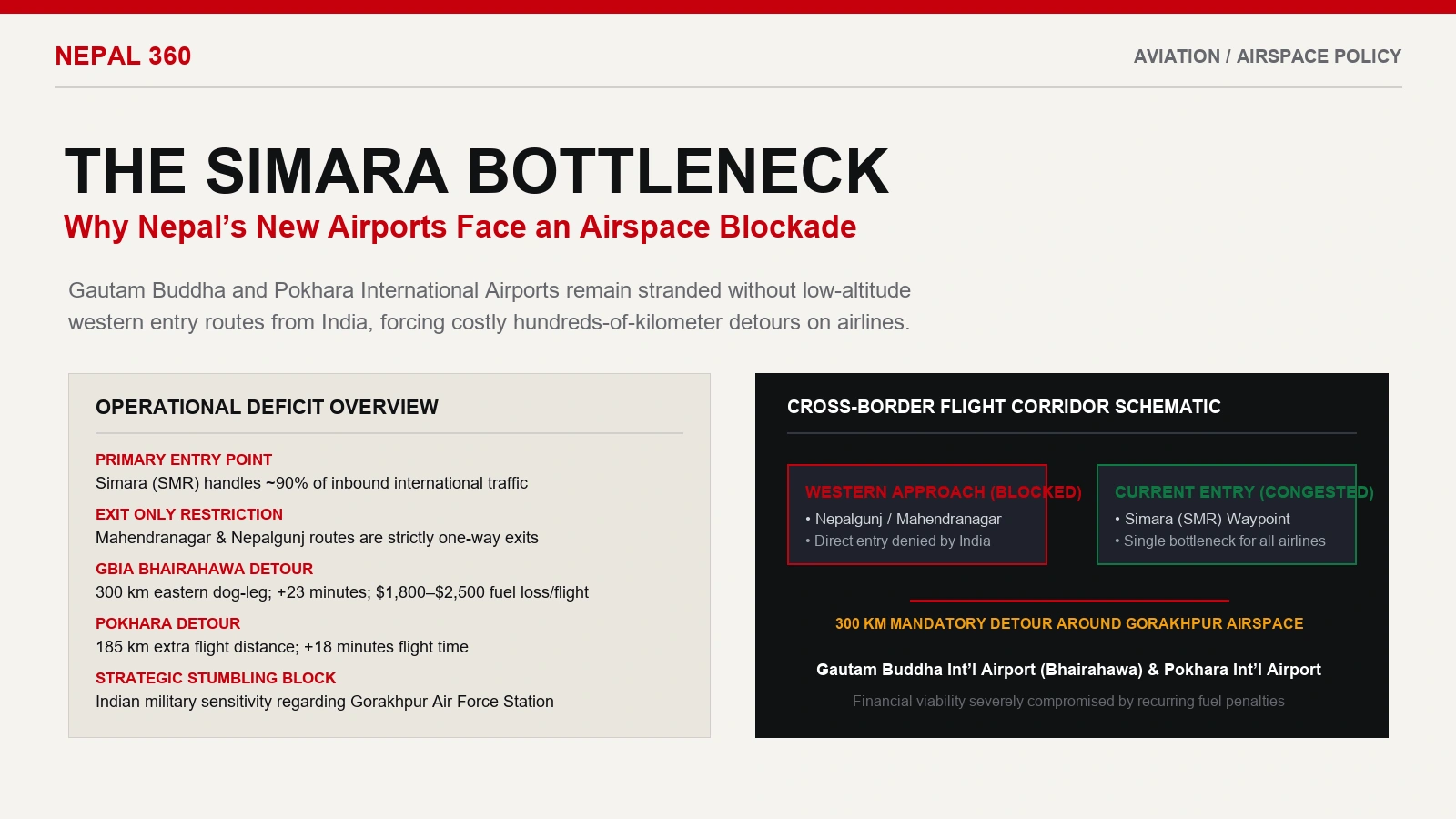
When Nepal inaugurated Gautam Buddha International Airport (GBIA) in Bhairahawa in May 2022 and Pokhara International Airport (PIA) in January 2023, the projects were envisioned as transformative national milestones. Together, they were designed to decentralize air passenger traffic away from Kathmandu’s congested Tribhuvan International Airport (TIA), stimulate provincial tourism, and establish direct international links for millions of migrant workers from the Tarai and western hills.
Yet, nearly four years later, both multi-billion-rupee provincial gateways remain severely underutilized, operating only sporadic regional charter flights and heavily subsidized service corridors. While commercial planning, ground handling logistics, and bilateral air service agreements have all played roles in this stagnation, aviation experts, airline executives, and government regulators agree on the primary structural bottleneck: Nepal’s persistent inability to secure low-altitude international air entry routes from India.
Without two-way cross-border entry corridors in western Nepal, incoming international commercial flights from the Middle East, the Gulf, and Europe are forced to bypass their destinations entirely, flying hundreds of kilometers eastward into Indian airspace before making a sharp loop back across Nepal’s southern plains. The resulting penalties in flight duration, fuel expenditure, and carbon emissions have crippled the commercial viability of both airports.
The Anatomy of the Bottleneck: The Simara Monopoly
To understand why Nepal’s new airports face an operational deadlock, one must examine the geographic and aeronautical realities of Himalayan airspace. Nepal’s northern border is bordered by the high Himalayas and the Tibetan plateau, where minimum safe altitudes frequently exceed 25,000 feet, severe turbulence is common, and commercial passenger corridors are sparse. Consequently, the vast majority of international flights entering and exiting Nepal must transit through Indian airspace to the south, west, and east.
Historically, cross-border air arrangements between the Civil Aviation Authority of Nepal (CAAN) and the Airports Authority of India (AAI) established multiple exit routes, but strictly limited low-altitude entry points. Out of all international aircraft flying into Nepal, between 88 and 90 percent are channeled through a single navigation waypoint: Simara (SMR), situated in south-central Madhesh Province, directly south of Kathmandu.
While Simara serves inbound traffic to Kathmandu relatively well, it creates severe aeronautical inefficiencies for airports located further west. Bhairahawa sits roughly 150 kilometers west of Simara, while Pokhara lies approximately 120 kilometers to the northwest. Because international flights are prohibited from entering Nepalese airspace directly over western border crossings, aircraft arriving from Dubai, Doha, Kuwait, or New Delhi must fly past Bhairahawa inside Indian airspace, continue east to the Simara waypoint, enter Nepal, and then execute an immediate U-turn to fly back west.
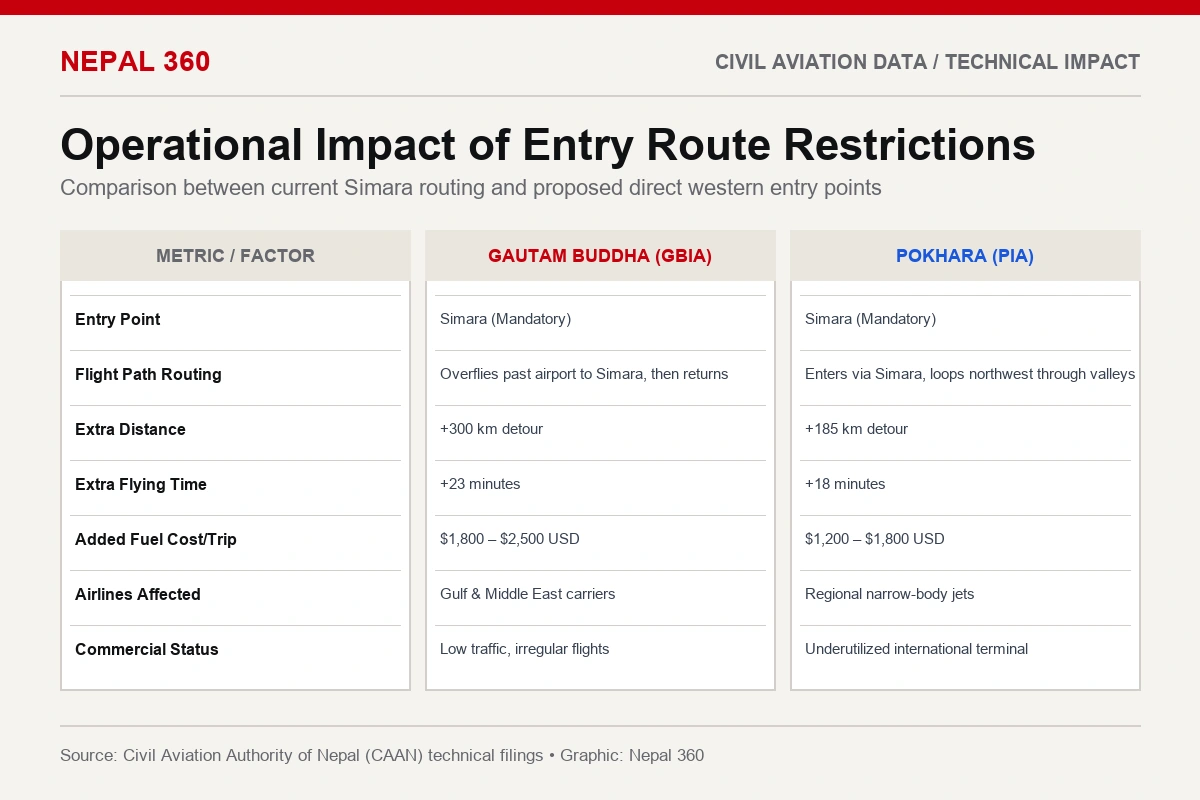
Comparison of routing penalties: Gautam Buddha (Bhairahawa) and Pokhara airports suffer significant distance and fuel penalties due to mandatory Simara entry. Graphic: Nepal 360.
The High Cost of the Detour: Distance, Time, and Fuel
The operational and economic consequences of this forced dog-leg route are staggering for commercial airlines operating on thin profit margins. According to technical flight profile analyses prepared by CAAN and international carrier feasibility teams, the Simara entry requirement imposes quantifiable penalties on every single inbound landing:
Airport | Mandatory Entry Point | Extra Route Distance | Extra Flight Time | Estimated Added Fuel Cost / Trip | Commercial Impact |
|---|---|---|---|---|---|
Gautam Buddha (GBIA) | Simara (SMR) | +280 to +300 km | +20 to +23 mins | $1,800 – $2,500 USD | Prohibitive operating costs for Gulf scheduled flights |
Pokhara (PIA) | Simara (SMR) | +170 to +185 km | +15 to +18 mins | $1,200 – $1,800 USD | Restricts narrow-body commercial viability from regional hubs |
For an airline operating a daily scheduled service using an Airbus A320 or Boeing 737 narrow-body aircraft, an additional 23 minutes of flying time translates into more than $700,000 in extra jet fuel and engine maintenance costs annually for a single route. In an industry where seat-mile revenue determines route survival, this artificial cost barrier discourages international operators from establishing regular schedules in Bhairahawa, even when passenger demand among migrant workers across Lumbini Province is high.
Furthermore, channeling all incoming flights into the Simara corridor creates persistent airspace holding patterns. On overcast winter days or during peak evening arrival windows, aircraft bound for Kathmandu, Bhairahawa, and domestic hops stack up over Simara, exacerbating fuel burn and schedule delays.
What Nepal Has Asked For: The Proposed Corridors
For more than a decade, the Government of Nepal and CAAN have formally petitioned India for additional two-way air corridors. Kathmandu’s primary proposals center on three strategic entry points:
Nepalgunj (L626 Corridor): Route L626 is currently operational as an international exit route, allowing flights leaving Nepal to enter Indian airspace near Mahendranagar and Nepalgunj. Nepal has repeatedly requested that India make this corridor bidirectional, allowing incoming flights from western hubs to enter Nepal at cruising altitude.
Bhairahawa Entry: Establishing a direct instrument approach corridor crossing the border south of Gautam Buddha International Airport, allowing straight-in descent and landing.
Janakpur / Biratnagar Corridors: Secondary bidirectional corridors to service eastern transit and regional connectivity between Nepal, Bangladesh, and India’s northeastern states.
Aeronautical simulations demonstrate that opening the Nepalgunj and Bhairahawa entry routes would immediately cut flight times to GBIA by 23 minutes and to Pokhara by 18 minutes, transforming the operating economics of both gateways overnight.
Strategic Constraints and Indian Stances
Despite numerous rounds of technical talks between CAAN and the Airports Authority of India, high-level diplomatic pledges, and joint working group meetings, progress on western entry routes has remained stalled. The primary stumbling blocks are deeply rooted in defense sensitivities, regional geopolitics, and civil aviation security.
Chief among India's stated operational concerns is the proximity of the Gorakhpur Air Force Station in eastern Uttar Pradesh. Located approximately 85 kilometers south of Bhairahawa, Gorakhpur is a strategic frontline base of the Indian Air Force (IAF), hosting frontline fighter squadrons and intensive low-to-mid-altitude military exercises. Indian defense authorities have expressed strong reservations regarding the creation of a dense commercial flight corridor directly adjacent to active military training airspace.
Geopolitical sensitivities have added friction. Both Gautam Buddha and Pokhara international airports were constructed with major Chinese financing or engineering contracts: GBIA was built by the Northwest Civil Aviation Airport Construction Group with Asian Development Bank financing, while Pokhara was developed through an engineering, procurement, and construction (EPC) contract financed by China's Export-Import Bank. Indian policymakers and state-backed entities have maintained a cautious diplomatic posture toward infrastructure projects carrying Chinese commercial footprints along Nepal's southern border.
Aviation Reality: Routes Alone Are Not a Magic Wand
While securing western entry points is indispensable for operational efficiency, aviation analysts caution against viewing air routes as an absolute panacea for the broader crisis facing Nepal’s airports. The commercial viability of Gautam Buddha and Pokhara is also constrained by domestic administrative bottlenecks:
Immigration and Labor Bureaucracy: Kathmandu has been slow to establish fully decentralized foreign employment offices, pre-departure health screening centers, and visa processing facilities in Bhairahawa and Pokhara, forcing many outbound migrant workers to still transit through the capital.
Airline Operating Incentives: Ground handling monopolies, high landing and parking fees, and inconsistent fuel pricing by the Nepal Oil Corporation (NOC) have historically eroded competitive advantages.
Instrument Landing Limitations: At Pokhara, surrounding mountain terrain restricts operations strictly to daylight visual flight rules (VFR) and required navigation performance (RNP-AR) procedures, capping aircraft size and weather tolerances regardless of Indian route clearances.
The Path Forward in Bilateral Talks
As cross-border connectivity takes center stage in high-level diplomatic exchanges—including Prime Minister Balendra Shah’s November 2026 state visit to New Delhi—the air route issue has transitioned from a technical CAAN dispute into a core sovereign negotiating item. Nepalese negotiators have framed reciprocal airspace facilitation as a win-win regional proposition, offering to coordinate airspace access for Indian regional flights operating near Bagdogra, Raxaul, and Patna in exchange for western corridors.
Until a binding bilateral agreement converts routes like L626 into two-way international corridors, Nepal’s provincial airports will continue to bear the heavy financial burden of the Simara detour. Resolving this aeronautical deadlock is not merely an engineering technicality; it is the fundamental prerequisite for transforming Nepal’s billions of rupees in aviation debt into productive economic engines.
How did this story make you feel?
The discussion
0Why Nepal’s International Airports Still Face an Air Route Problem
Your perspective matters.
Sign in to share your thoughts and reply to other readers.
Reader perspectives
Newest firstStart the conversation
No comments yet. A thoughtful perspective can make this story go further.