
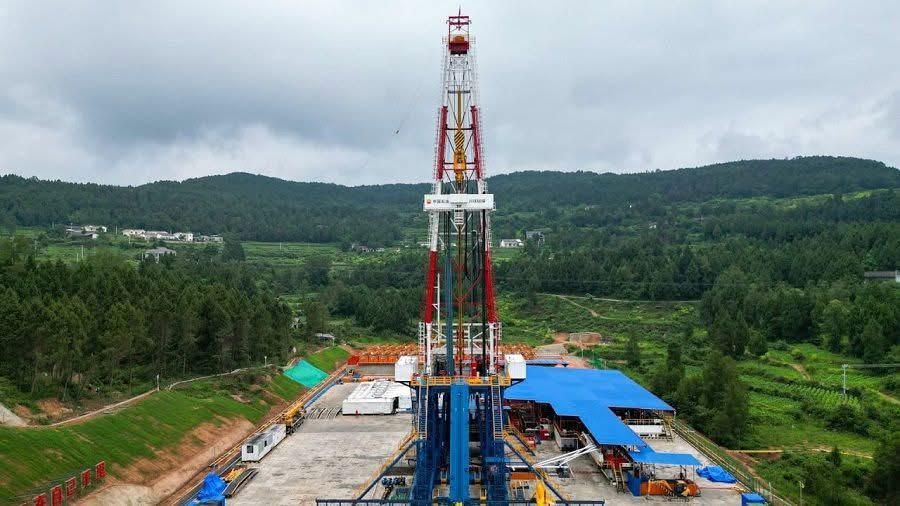
Dailekh, Nepal – In what could be a game-changing discovery for Nepal’s energy future, preliminary geological studies have found an estimated 112 billion cubic meters of natural gas in the Jaljale region of Dailekh district. The finding, made by a Chinese geological team, has raised high hopes among Nepalese officials for the country’s long-term energy independence.
Government representatives say the reserve, if proven commercially viable, could supply Nepal's natural gas needs for the next 50 years. This major breakthrough has brought fresh optimism to Nepal’s energy sector, which has long relied heavily on imported fossil fuels.
How the Discovery Was Made
The survey and drilling work were initiated jointly by the China Geological Survey, a key government institution of China, and CNPC Xibu Engineering Company, a subsidiary of China’s national petroleum corporation. The project officially started on Baisakh 28, 2080 B.S. (May 10, 2023 A.D.).
As part of the study, the team drilled as deep as 4,000 meters underground, searching for signs of natural gas. According to officials involved in the project, a strong smell of gas was detected during the drilling phase—an early sign of potential hydrocarbon presence.
However, the discovery needed more evidence. So, rock samples were carefully collected from the drilling site and transported to China for advanced laboratory testing. These tests were conducted to understand both the quantity and the quality of the natural gas trapped beneath Dailekh’s surface.
What the Preliminary Report Says
The initial analysis by Chinese geologists has now confirmed the presence of around 112 billion cubic meters of natural gas in the region. The report also states that if managed efficiently, this supply could last Nepal for about five decades. These numbers have not been finalized yet, but early indicators are very promising, according to energy experts.
Is the Gas Reserve Commercially Viable?
While the volume of gas found is impressive, the next question is whether the reserve is commercially usable. That means determining if it is economically possible to extract, process, and distribute the gas in a cost-effective way.
The ongoing study is designed not just to find gas, but also to see if the location, depth, and extraction cost make the resource usable for business and public use. According to experts, more detailed surveys and cost-benefit analysis will be required before full-scale extraction can begin.
A Big Hope for Nepal
Nepal currently imports most of its petroleum products, including LPG (cooking gas), petrol, diesel, and kerosene, mainly from India. The rising prices and dependency on foreign countries have often affected the country’s economic stability and energy security.
This new discovery has the potential to transform Nepal’s energy landscape by reducing its dependency on imports. It could also lead to the development of local industries, the creation of new jobs, and improvements in the country’s economic condition.
Voices from the Government
Government officials, especially those working in the Ministry of Industry, Commerce, and Supplies, are enthusiastic about the early findings. A senior official commented,
“This could be the beginning of a new era for Nepal. We are closely watching the progress and preparing to develop necessary infrastructure.”
Environmental and Safety Concerns
While the discovery has generated excitement, experts have also reminded that environmental safety must be a top priority. Deep drilling and gas extraction can impact the environment if not handled properly. The government is expected to follow strict environmental guidelines before any industrial-level drilling starts.
Next Steps Ahead
Here’s what will happen next in the process:
Final Lab Report – Full lab analysis of the rock samples from China will give more accurate data.
Feasibility Study – Economic and technical viability of extracting the gas will be studied.
Environmental Impact Assessment (EIA) – Government will evaluate the environmental risks.
Infrastructure Planning – Roads, pipelines, and storage facilities need to be built.
Investment and Policy – Nepal may seek investors or partnerships for full-scale production.
Local Reactions in Dailekh
Residents in Dailekh have expressed both excitement and concern. Many are hopeful that this discovery could bring economic development and job opportunities to the area, which has remained underdeveloped for decades.
A local resident said:
“We hope this gas will not just benefit Kathmandu but also bring roads, electricity, and schools to our village.”
The discovery of a large natural gas reserve in Dailekh’s Jaljale is a historic development for Nepal. While much work remains before gas can be extracted and used, this preliminary success marks a strong step toward energy independence and economic progress.
Nepal now stands at the edge of an energy revolution. With smart planning, environmental care, and international collaboration, Dailekh’s natural gas could fuel the nation’s growth for generations to come.
Comments
0