
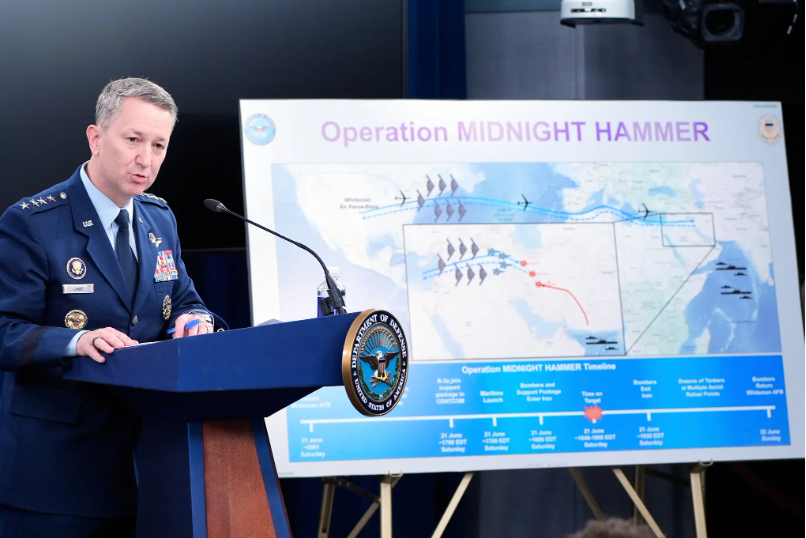
Iran has vowed to defend itself and respond with “severe consequences” after the United States military, in coordination with Israel, launched a surprise joint attack on three of Iran’s major nuclear sites early Sunday morning.
The U.S. airstrikes and missile attacks targeted what American officials claimed were nuclear enrichment facilities central to Iran’s suspected weapons program. According to U.S. President Donald Trump, who addressed the nation from the White House, the objective was the “complete destruction of Iran’s nuclear enrichment capacity.”
“The nuclear sites have been completely and totally obliterated,” Trump declared in a short, nationally televised message.
This marks the most direct U.S. military action against Iran in years and dramatically escalates the already tense situation in the Middle East.
What Happened?
Around 2:15 a.m. local time, missiles and guided bombs struck nuclear facilities in Natanz, Fordow, and Arak—three highly secured Iranian nuclear sites. Loud explosions lit up the night skies and were followed by widespread power outages across surrounding regions.
Iranian state television confirmed that the sites were hit but did not provide immediate details about casualties or the scale of destruction. Unverified satellite images circulating on social media show plumes of smoke and damaged infrastructure at the Natanz site, one of Iran's most heavily fortified nuclear plants.
In a strongly worded statement, Iran’s Supreme National Security Council said:
“This unprovoked act of war will not go unanswered. Iran reserves the right to respond at a time and manner of its choosing.”
Global Shockwaves
The sudden attack has sent shockwaves across the international community. Russia and China have both condemned the strike, calling it a violation of international law and a threat to global peace.
The United Nations Security Council has called an emergency session to discuss the crisis. Secretary-General António Guterres urged all sides to exercise maximum restraint.
“The risk of full-scale regional war has never been higher,” Guterres warned.
European leaders, including those from the United Kingdom, Germany, and France, have called for an immediate ceasefire and return to diplomacy.
What’s Behind the Attack?
Tensions have been building for weeks, especially after Iran was accused of increasing its uranium enrichment levels beyond the limits set by the now-defunct 2015 nuclear deal.
Israel has long viewed Iran’s nuclear program as an existential threat. Recently, Israeli intelligence claimed Iran was “within months” of building a nuclear bomb. President Trump, who previously withdrew the U.S. from the nuclear agreement in 2018, reiterated that military action was necessary to ensure global safety.
“We will not allow Iran to hold the world hostage with nuclear weapons,” Trump said Sunday.
Sources say Israel provided intelligence and logistical support, while the U.S. Air Force executed the bulk of the bombing mission.
Iran's Response
Iran has activated its air defense systems across the country and placed its military on highest alert. Iranian President Ebrahim Raisi called the attack “an act of terrorism,” vowing Iran will respond “with force and purpose.”
Massive street protests erupted in Tehran and other major cities, with chants of “Death to America” and “We will retaliate.” Iranian military leaders have hinted at potential counterattacks on U.S. bases in Iraq, Syria, and the Persian Gulf.
In response, the U.S. Department of Defense has ordered the evacuation of non-essential personnel from its embassies in the region and increased the alert level at all overseas bases.
Fears of Wider War
The attack raises serious fears of a broader regional war. Hezbollah in Lebanon and pro-Iranian militias in Iraq have already vowed to join Iran’s cause. Israel has placed its Iron Dome missile defense systems on full alert and is preparing for possible rocket attacks.
Oil prices skyrocketed by over 10% within hours of the news, and stock markets around the world saw sharp declines as investors brace for further instability.
The Strait of Hormuz, through which 20% of the world's oil supply passes, has become a flashpoint. Iran has threatened to block the narrow waterway if attacked again, a move that could cripple global oil shipments.
What Happens Next?
The situation remains extremely tense, with no clear path forward. While the U.S. and Israel may see the attack as a tactical success, many experts fear it could spark years of unrest or even a new regional war.
Analyst Reza Marashi, a former U.S. State Department official, said:
“This is not just about nuclear weapons. This is about power, influence, and pride in the region. Iran will not take this lightly.”
International diplomatic efforts are now racing against time to prevent further escalation. Meanwhile, millions across the Middle East—and the world—wait with bated breath.

Comments
0