
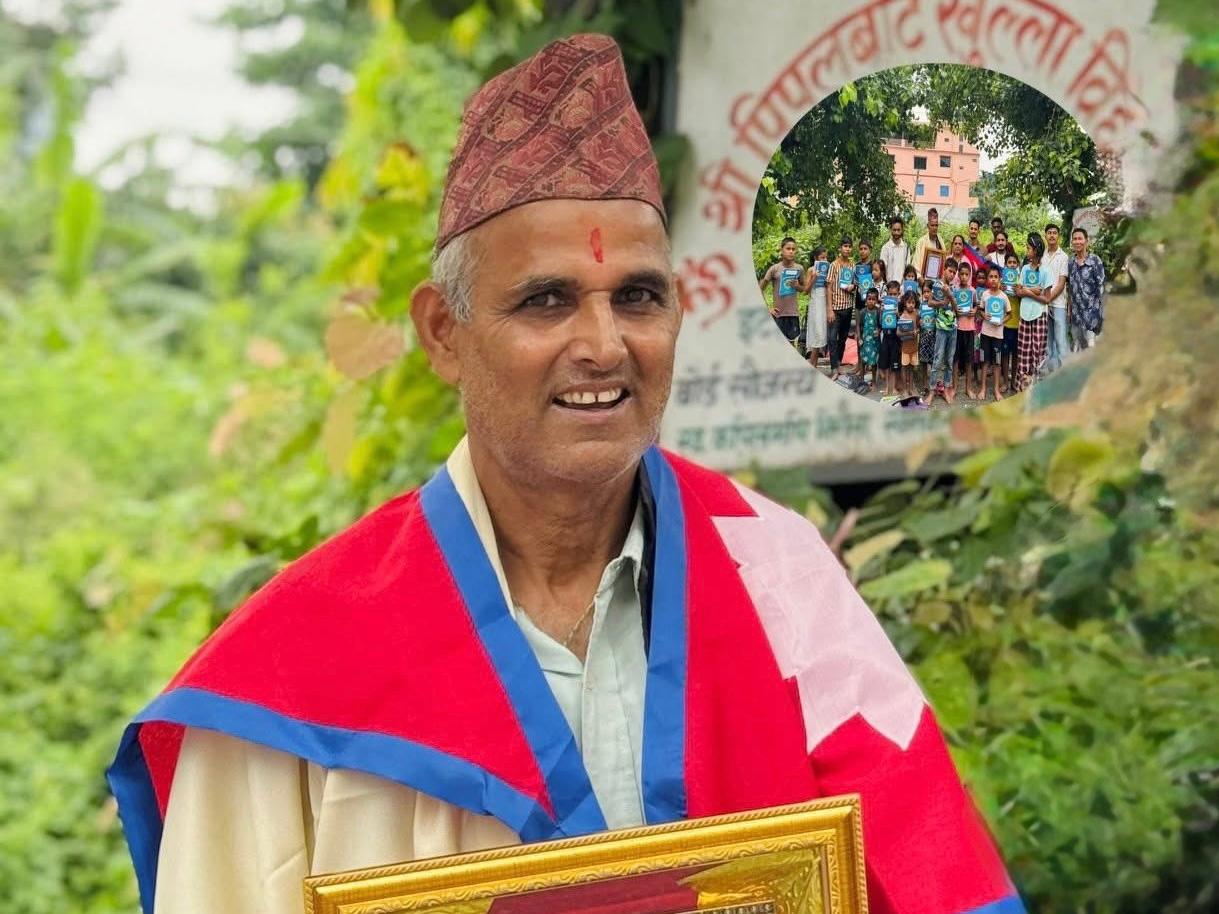
A true man's story is to be honored by society and the system. Imagine a man, day after day, sitting under a sprawling peepal tree, surrounded by eager children with no books, no desks, just a thirst to learn. This is the story of Chandra Bhandari, a beacon of hope in Itahari, Nepal, who has spent 31 years teaching underprivileged kids for free. His classroom has no walls, but its impact stretches far beyond the shade of that tree.
In Itahari, a bustling sub-metropolitan city in Sunsari district, many children from poor families once roamed the streets, far from classrooms. Schools were often too expensive or too far, and parents, struggling to survive, couldn’t prioritize education. Chandra, a local with a heart full of purpose, saw this gap. Thirty-one years ago, he decided to act. Armed with little more than chalk, a small board, and determination, he began teaching under a peepal tree, a sacred symbol in Nepal, turning it into a sanctuary of learning.
Chandra’s journey wasn’t planned. He wasn’t a trained teacher with a degree or a government job. He was a man who couldn’t ignore the sight of children missing out on their future. Posts on X highlight how he noticed most kids in his neighborhood weren’t attending school. So, he gathered them under the tree, starting with basic reading and writing. Word spread, and soon, dozens of children showed up daily, their eyes bright with curiosity.
What makes Chandra’s work extraordinary is its simplicity. He doesn’t charge a penny. In a world where education often comes with a price tag, he offers it freely to those who need it most. His students, often from marginalized communities, face challenges like poverty, caste discrimination, and lack of resources. Yet, under that tree, they find a safe space to dream. Chandra teaches them Nepali, math, and English, but more than that, he teaches them hope.
Itahari, though growing as a commercial hub, still grapples with educational inequality. A 2019 report noted that 32 million Indian children—Nepal’s neighbor—never attended school, and Nepal faces similar issues, with many rural and poor urban kids left behind. Chandra’s efforts directly address this. His tree classroom serves as a grassroots solution, proving that one person can spark change. He doesn’t wait for government policies or NGO funds; he just teaches.
Over the years, Chandra’s students have gone on to achieve remarkable things. Some have become teachers, others shopkeepers, and many are now literate parents who value education for their kids. His work breaks the cycle of poverty, one child at a time. A local shared on X that Chandra’s dedication has inspired others in Itahari to support community education. His influence ripples, showing how small acts of kindness can transform a neighborhood.
Chandra’s life isn’t easy. He supports himself through modest means, possibly small-scale farming or community contributions, though details about his personal life are scarce. What’s clear is his unwavering commitment. Rain or shine, he’s there, under the peepal tree, his voice steady as he explains letters or numbers. The tree itself has become a symbol in Itahari—a place where futures are built.
Nepal’s education system faces challenges like teacher absenteeism and poor infrastructure, especially in rural areas. Chandra’s approach sidesteps these hurdles. He doesn’t need fancy buildings or digital tools. His classroom is nature itself, and his passion is the curriculum. This resonates with global calls for equitable education, like India’s Supreme Court ruling in 2021 that access to learning can’t be denied to underprivileged kids. Chandra lives by this principle daily.
His story also reflects Nepal’s cultural values. The peepal tree, often tied to wisdom in Hindu and Buddhist traditions, adds a layer of meaning to his work. It’s as if the tree itself blesses his mission, offering shade and serenity to children who might otherwise be working or wandering. Chandra’s choice of this spot wasn’t random; it’s a nod to community spaces where people gather, learn, and grow.
Despite his impact, Chandra remains humble. He doesn’t seek fame or awards. His reward is the smile of a child who reads their first sentence or solves a math problem. Locals in Itahari speak of him with reverence, calling him a true hero. His work aligns with efforts like those of Divanshi Bhandari, a student in India crowdfunding for underprivileged kids’ education, showing a shared spirit of giving back.
Chandra’s story challenges us to rethink education. It’s not about buildings or budgets; it’s about heart. In a world of complex problems, his solution is beautifully simple: show up, teach, care. His 31 years under the peepal tree remind us that one person’s dedication can light up countless lives.
As Itahari grows, Chandra’s tree-classroom stands as a quiet revolution. It’s a call to action for communities everywhere to support their most vulnerable. His legacy isn’t just in the lessons he teaches but in the futures he unlocks. Under that peepal tree, Chandra Bhandari is sowing seeds of change, one child at a time.

Comments
0